“..duende loves the edge, the wound, and draws close to places where forms fuse in a yearning beyond visible expression.”
from Theory and Play of The Duende
“..duende loves the edge, the wound, and draws close to places where forms fuse in a yearning beyond visible expression.”
from Theory and Play of The Duende
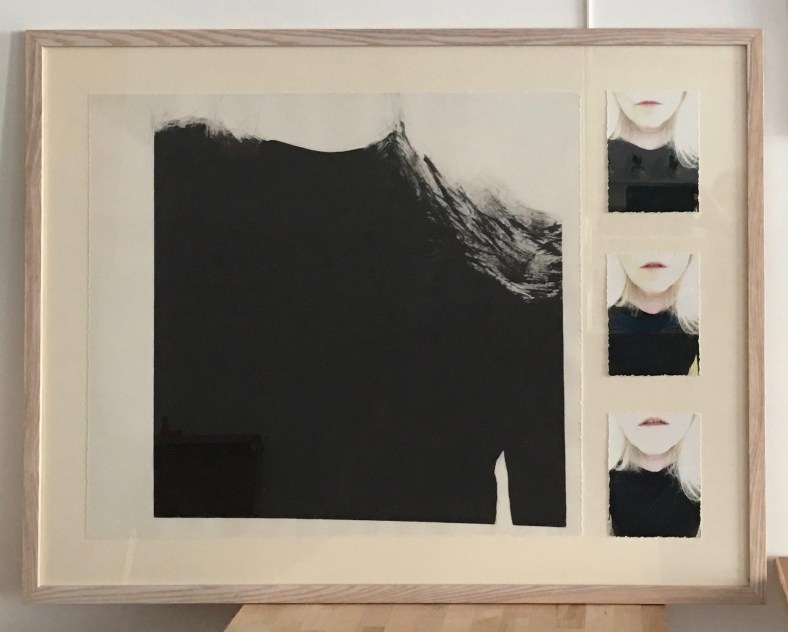
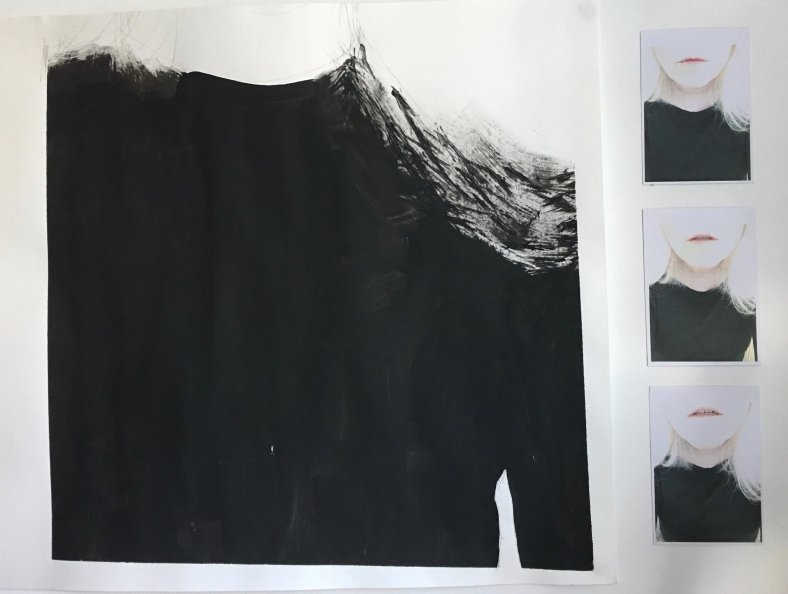
I’m delighted with the end result of the work I used to illustrate the ‘Duende’ post recently. A supporter of my work and the arts hub I co-run in my home town saw it during our recent open studios and decided to buy it. I hadn’t actually intended it to be for sale, I had hung the painting, and the 3 photos which inspired it, together – more as an illustration of a kind of development, then as a display of finished work. However a few people commented on it, and then our customer came in unexpectedly and wanted it. I thought about it and decided to put it together in a more finished way, so I had the painting printed, and mounted with the 3 photographs to create a finished ‘piece’.
The great thing is that the customer is not someone who shirks from the darker aspects of my work. She and I have had conversations about such things, and she is open to them. The work I called ‘Floating’. It’s subject matter is dissociation. In it I am trying to convey the feeling of dissociation during and after trauma, when you feel that your head and body and separated to protect them both. I remember telling my husband that the sensation was rather like what happens on an Apple computer when you ‘duplicate’ something, it kind of pops out a copy which then sits in front or to the side of the original. On looking at this work of the photos and the painting, I realise that it illustrates this sensation of duplication or of being being ‘beside yourself’. The top of the head is missing also, of course (the ‘floating’) which suggests the sense of being missing from your old sense of self that comes with dislocation during the survival of the trauma itself, but also with the sense of unreality that came with the morphine and morphine-like drugs later on. The black jumper also suggests to me the dark dark heart of experiencing trauma, and in particular facing the possibility of dying and the blank finality of death.
As I say, the customer does not shy away from subjects such as these and demand a ‘sunny’ artwork (although she likes those too, who doesn’t?). I am incredibly grateful for this and it give me the strength to continue to work on my ideas for an exhibition of some sort in the future, based on the experience of liminality, and the phenomenology of trauma.
Floating – Print of Mixed Media – Painting & Photography
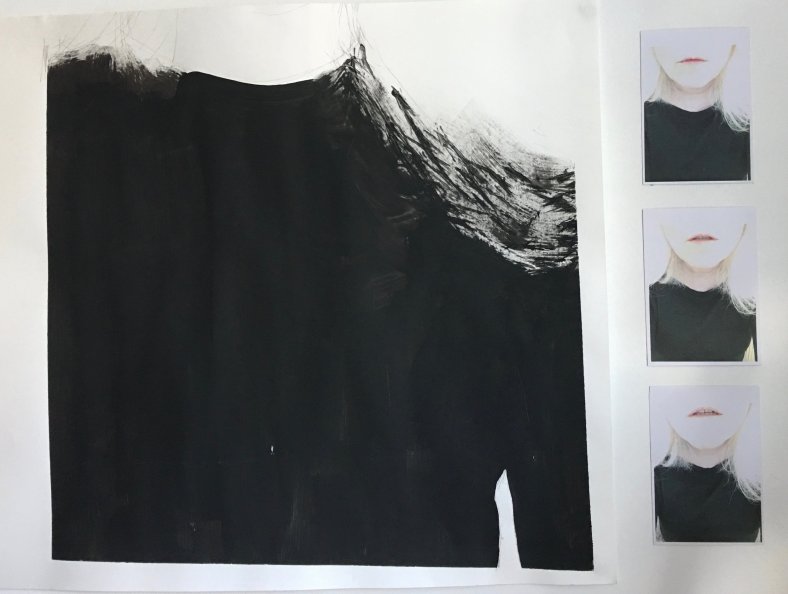
Nick Cave calls it ‘the eerie and inexplicable sadness that lives in the heart of certain works of art’. Duende is the tragic awareness of death in life and when artists are possessed by it, their work resonates in ways mere skill or artistry can never achieve.
The Perfume Lover, A Personal History of Scent – Denyse Beaulieu
‘Seen, unseen, loss’ – mixed media painting, drawing and photography
The liminal, the in-between state, the uncanny and take-you-out of the norm state, music can conjure up such feelings in the listener, it can describe the indescribable, like poetry, it can make the sounds that voice cannot reach. Music sniffs out the underdog emotion, the one which doesn’t get much airing because its difficult. This is a playlist of music I find strums this accord in me. Some are about death, some aloneness, one is about a depressed town, and another about a dying society – some I don’t know what they are about, they just make sounds which to me express the liminal:
Swanlights – Antony & The Johnsons
Words – Ane Brun
Fuel to Fire – Agnes Obel
Immigrant Song – Karen O & Trent Reznor
Everything is New – Antony & The Johnsons
Child Bride – CocoRosie
You Want it Darker – Leonard Cohen
Gravediggress – CocoRosie
Electric – Kathryn Williams
Battleships – Kathryn Williams
Steer Your Way – Leonard Cohen
When Under Ether – PJ Harvey
Baltimore – Nina Simone
The Spirit Was Gone – Antony & The Johnsons
This City Never Sleeps – Eurythmics
If You Need to, Keep Time on Me – Fleet Foxes
Beating Heart – Kathryn Williams
When Nothing Meant Less – Kathryn Williams
The first thing I want to mention is that I took part in a week long course a couple of weeks ago, and the tutelage of Fraser Taylor, entitled ‘develop your studio practice’, I wanted to spend some dedicated time trying to see if I could pull together some of the strands I’ve been following over the last few months, grappling with ideas for making art related to my experiences of being involved in a serious accident which resulted in sight loss. The sense of being in a liminal state pervaded my life afterwards, and one of the only ways I could feel my way through it was to try and express it through making art in various forms. But how to pull together something which was by its essence broken, fragmented, full of blanks (like my eyesight, and memory) and without a visible end? The course was excellent and Fraser immediately grasped what I was saying and understood that the liminal happens also on the verges of different forms of art, which was also something I was drawn to. The sense of feeling my way (blindly) isn’t something I need to resist, in itself this mirrors the experience. I pull together as best I can, but the gaps keep opening, resisting any attempts to be controlled. This is, surely a creative process in itself. The end result can only be an exhibition, or perhaps a small scale exhibition in the form of a book, or a few books…..
Saying that, next week I am putting some work of mine up together in one space for an open studios event and following exhibition. This is for the ‘outward me’ to put some work into public and see what happens.
“I am from peasant stock with a shit degree in art – I’m a nothing,” she says. “But it doesn’t take an expert to diagnose the whole stinking system. I talk to a taxi driver from Pakistan and they’re saying the same thing as me. Everyone’s feeling it. David Attenborough’s feeling it; all the people we trust are feeling it. Can we address it? Can we inhale it? Can we withstand it?” https://www.theguardian.com/music/2016/apr/09/trans-singer-anohni-new-album-hopelessness
“Real culture happens in communities, not galleries.” – Partisan, Manchester, article by Kate Hardy & Tom Gillespie, Guardian 4th August 2017
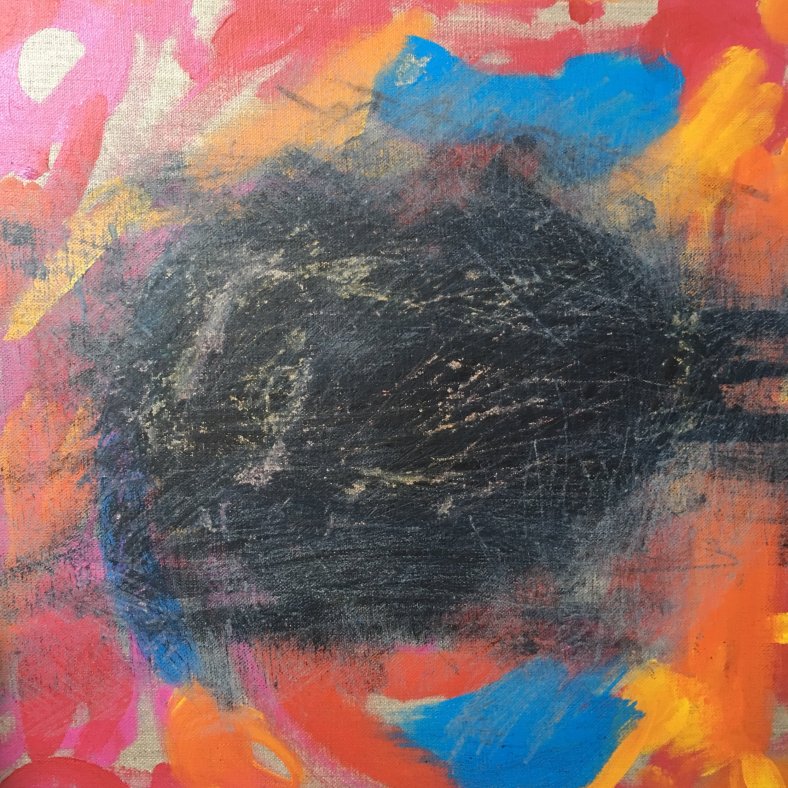
I’m feeling very frustrated right now because I have this tendency to work on something and then sabotage it. I’ll follow an idea, one which I might have worked on mentally outwith the studio, and by the time I get to the canvas I have a clear purpose. Then I execute it, give or take the usual varieties of unexpected moments, which are good and productive. Then I go away but when I return I look at the piece and feel self doubt. Will people think I haven’t thought this through? Will they think it looks poorly executed? Does it look like something else (a head, a face). So I carry out some sort of vandalism on it. I think at the time I’m ‘working’ on it to improve it. Then I go back again later, I see the photographs I have taken of it previously and I’m furious to discover that it was actually exactly as I had wanted it to be, but I have spoiled it.
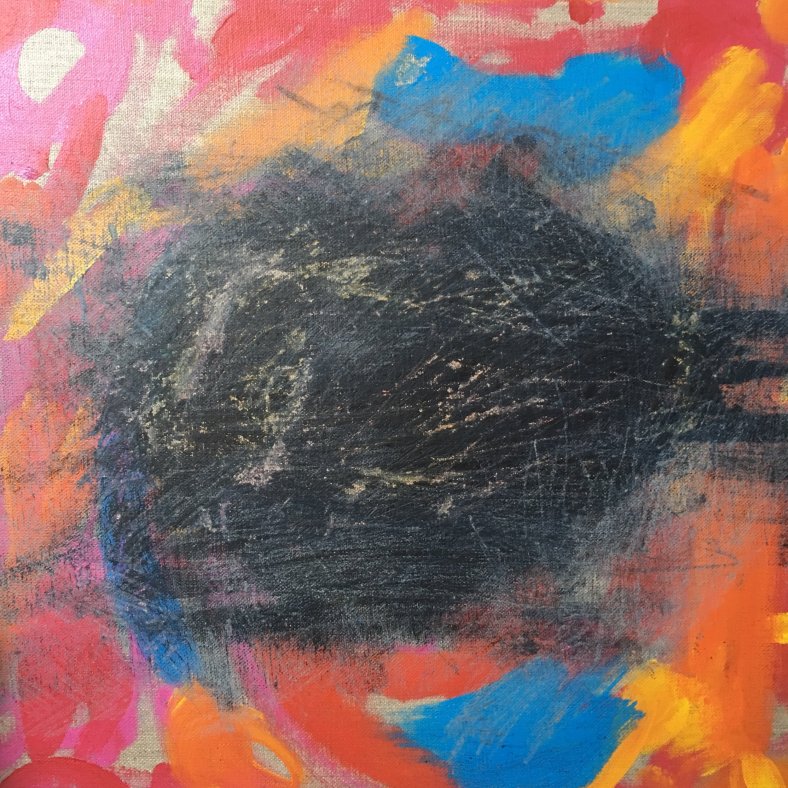
Here is an example. I wanted this to be a background of pure and simple colours, joyfully springing about, not my usual thing at all. I was delighted to use pink and red. This was a moment of pure painterly joy, balancing as you go, making movements with surety. Then the foreground was to be a lurking darkness, a sinister ‘being’ hovering over the joyfulness of the background. The painting represented to me the world of sight and joy which is now cut off for my right eye. It represents the horror I feel when I close my left eye and look only with my right. If both eyes were affected the same this is what it would be like to see the world at all. That I can still see things of joy with my left eye is so important and precious to me.
But when I went back I doubted my work. I painted first an indigo wash, and then a blood red one over that. The bright true colours are gone, although the pinks and reds are still visible. I was pulled into thinking I had to verify my work against some imagined critic. This makes me think that I need to work more in a tutored environment, where someone can recognise my work as it is in progress. By working in a vacuum where I produce and then sell, I feel rather lost. I have also learned from this though, I am much less likely to trust this horrible tendency to change things when I hear horrible criticisms in my mind. it is probably wrong!. Having confidence while you are working is one of the hardest things of all!
Here is the original painting:

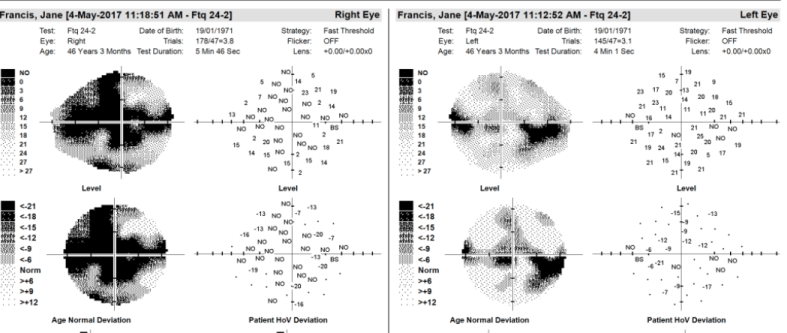
a test of my visual field. A very graphic representation of what I see. It is the closest I’ve been able to get of a subjective sense of my vision after a traumatic accident last year caused retinopathy in both my eyes. The top left image is a representation of when I could see a small flashing light on a screen, and at what brightness I could see it. The black is marked NO, i.e. no vision, and the gradations around it represent how bright the light needed to be in order for my eye to see it. The bottom left image is a comparison with normal vision i.e. ‘Norm’. The images on the right are my left eye. I knew that it’s wasn’t totally normal, there there was damage around the edges, but it just feels ‘reduced’ rather than having an actual blank spot as in my right eye. These images lend themselves to making art which express the subjective experience of low vision. I’ve started with a simple drawing of the right eye’s vision:

 JANE FRANCIS