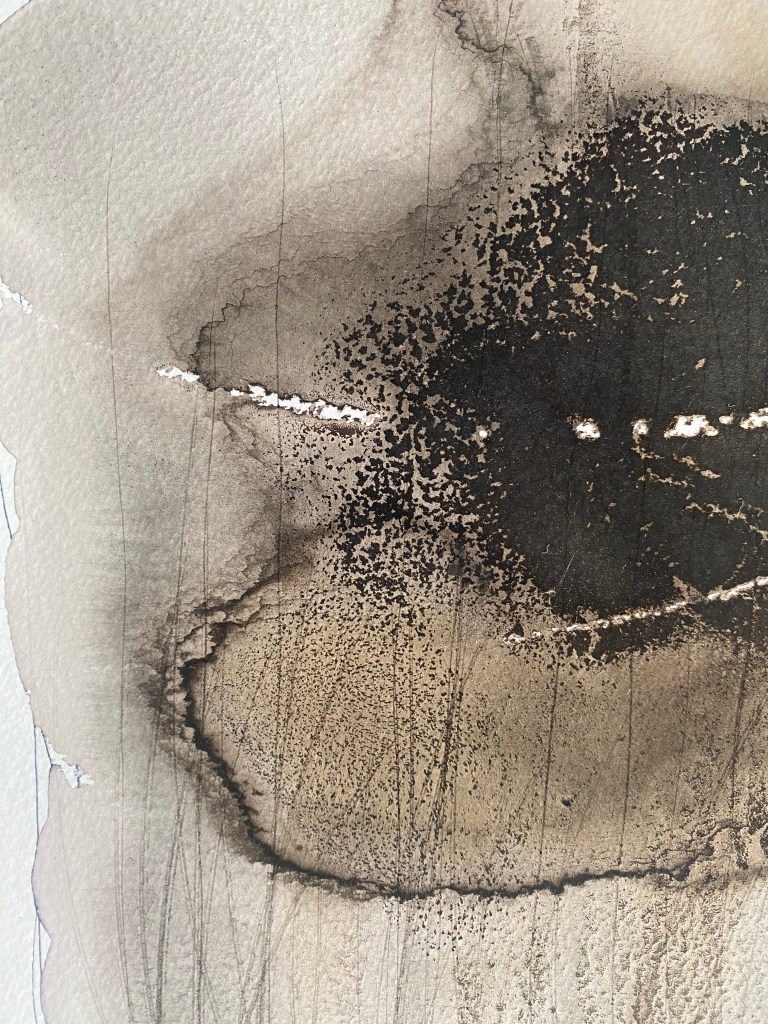


The autistic mind finds context from meaning. The allistic mind finds meaning from context – Dr Chloe Farahar – Aucademy, Thinking in Pictures, 08/01/21
This body of work was the result of a a combination of research and practice I undertook over a 12 month period in 2022-23. I combined research and the development of my conceptual understanding of the neurodiversity paradigm*; including neurodivergence, neuroqueering, monotropism & polytropism, and the double empathy problem, through the writings of Nick Walker, Dinah Murray & Fergus Murray, and Damian E.M. Milton and others. In the work I developed, I playfully explore these ideas materially and metaphorically, in varied scale, mixed-media work, using botanic pigments created from plant materials foraged on areas of land which are considered ‘use-less’ to hyper productive, capitalist/neoliberal society. They included a council managed piece of land where people were burned as witches in the 17th century, and an abandoned ex quarry, now become rich in biodiversity and valued by local people as a wild place, but under planning application to become a housing estate. It was important for me that the plants and other material I gathered were from these particular terroirs for their direct analogies with neurodivergent experience.
I had the initial idea for the NEURO{}PONDS (which got their name later) from a day when I was very depleted in energy and my ability to cope with any more social stimulation and overhead. I had a sudden vision of a metaphor for how I was feeling. We humans could be likened to ponds. We are ‘bodies of water’ – to put it tongue in cheekily. I had a visual sense that I was like a deep pond filled with complex life, strange and alien and monstrous, not immediately visible, sometimes even to itself. Its entanglements with its surrounding soil was oblique, murky, and impossible to separate into its contingent parts, it was a process more than a discrete ‘thing’. Its surface area was small, had few plants visible and was not open and accessible to insects and animals who use the surface of water for its habitat. I felt, like the water surface, invisible, and dormant, and possibly even hybernetic, particularly on that day when I was finding it impossible to ‘project’ an illusion of a more open wide surface area. When viewed from above the deeps of the pond would not be visible – certainly not its invisible, mysterious ecosystem with myriad interconnections with its surrounding environment.
I pictured many fellow ponds around me with a wide open surface area, with lots of detail in the form of plants and insects and animals, where all of their complexity occurred, while it didn’t stretch so far underground. Its connection to its surrounding environment would be complex, direct, uncomplicated, and immediately apparant. It was in effect, flipped from my form of pond.
It occurred to me that if those two types of pond were able to view each other from above, perhaps from some dragonfly ‘spies’, they would not be able to understand each other, since they were operating under the assumption that all ponds were probably much like themselves. The ponds with the small tops but complex depths of water would assume that the ponds with the wide tops had a similar scale of depth and complexity as themselves underneath but invisible, so they were managing both areas of complexity with an incredible ability, far beyond their own capacities.
For the ponds with the wide open tops, I wondered if they would assume that the marvellous world of top level complexity was the whole world, as they had no concept of the dark and mysterious pond waters below the others. For them, the lack of surface complexity would look like a a terrible deficiancy. I knew that use of the terms ‘deep’ and ‘shallow’ are unfortunate, as they already have cultural values assigned to them, so I began to thing of long ponds and wide ponds. After this vision I began to draw with ink what I was imagining, and I was using a hand made ink I had been gifted, made from oak galls, so that added a particular sense of something which could be the viscous, dense and layered.
A few days after this metaphorical vision and the beginnings of making visual representations of it, I read for the first time about Damien Milton’s double empathy problem, and it pleased me that I had struck upon a visual metaphor for this. In the latter stages of the project, I would discover the philosophical works of Edourard Glissant, and in particular his theory of a ‘right to opacity’ which spoke to me of the deep mysteries of the long pond’s depths. In a mirrored version of my ponds I found his archipelagos:
“These archipelagos must encounter each other because, across their many islands, interdependence and difference coexist – and, in this way, they carry the energy that is necessary for our whole globe, our whole world. We might currently believe that this energy derives from military or economic force, but that is not so. It lies in the ideas and the poetics of how we organise the world…They open us to a sea of wandering: to ambiguity, to fragility, to drifting, which is not the same as futility.” from a conversation between Glissant and curator Hans Ulrich Obrist
And
“We need archipelagic thinking, which in one that opens, one that conforms diversity – one that is not made to obtain unity, but rather a new kind of Relation. One that trembles – physically, geologically, mentally, spiritually – because it seeks the point, that utopian point, at which all the cultures of the world, all the imaginations of the world can meet and understand each other without being dispersed or lost.”
I created handmade inks from plant materials foraged around my home, commercial inks and watercolours made by small artisan makers. I developed a process, using the water based materials to flood the surface, while being attentive to their movements, directing and responding, each decision creating new possibilities, a conversation between my acts and the work itself. What emerged were energetic expressions of change as it was occurring, in my mind and on the painted surface. In the studio I read poetry before and during working, and listened to certain kinds of music, creating ritualised states of mind, beyond linear, rational thinking and lifelong programming.
I consider the resulting work to be figurative. They are entities, as I call them, or presences, operating in conversation with each other. The surfaces and depths of the ponds are able to be seen together on one plane, playing with a flattening of space. The forms don’t necessarily have to reference themselves becoming figurative, because their motifs have a painterly influence.
Entities emerged as something more like vessels – containing their squirming processes like leaky goblets. Just like a real pond, which is not a discreet thing, after all, but a series of processes between water, soil, air and countless living entities. My ponds/vessels/entities float alone, are intertwined with each other, or gather in groups. In some I explore possible connection and disconnection, based on expectations of what a neurology is ‘like’, and between neurodivergent individuals and a neuronormative construction of reality.
They took on a being-ness of their own, as entities, that was monstrous, other, and in the end I was focusing not so much on the difference between my own sense of internal understanding in comparison with normatively, but on celebrating the long pond, the depths, the weird and the other, in their own right, in the culmination of the project in 4 paintings, Neuroponds 1-4: Fluidity, Snails & Crows, Euphoria, and Layers of Abstraction.
By the end of the period I had discovered many works of theory, poetics and autobiography, and near the end I landed on the shores of the philosophical works of Edouard Glissant, Bayo Akomolafe and Erin Manning. These readings have formed a bridge from the Neuroponds project to my current practice in which I am responding to concepts and lived realities of processual ontologies and their relations across several fields.
* a term I first rencountered in Nick Walker’s book ‘Neuroqueer Heresies, Autonomous Press 2021
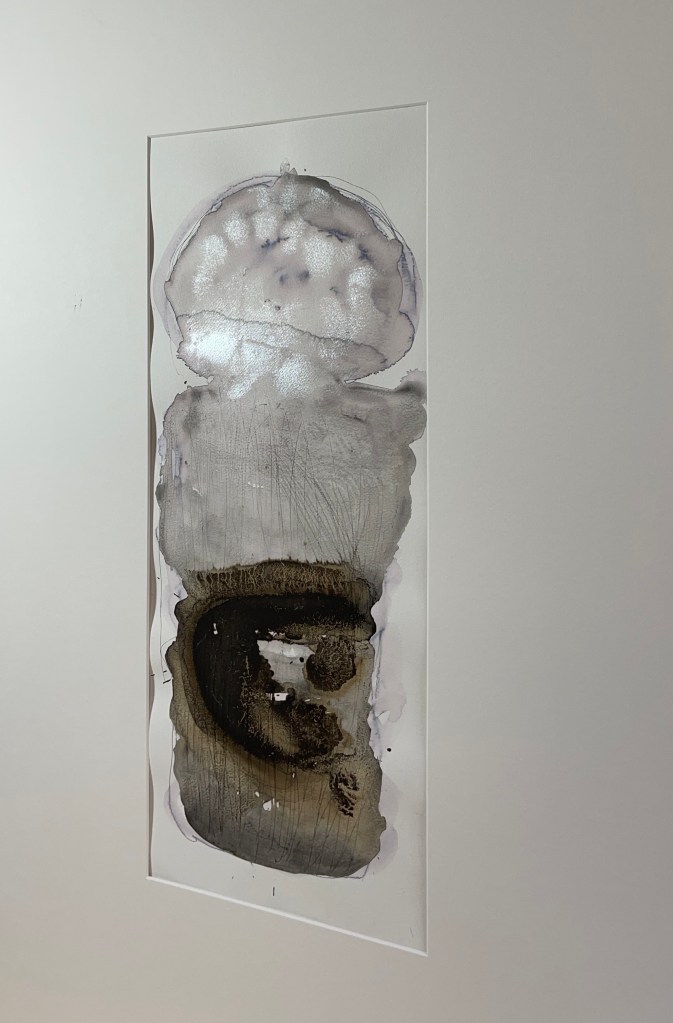
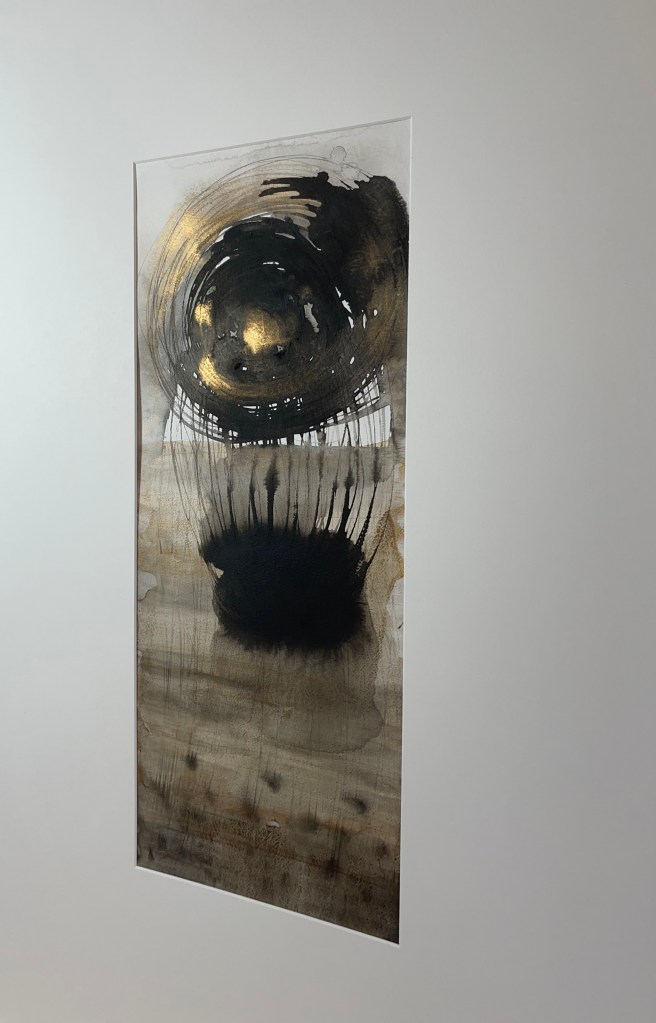
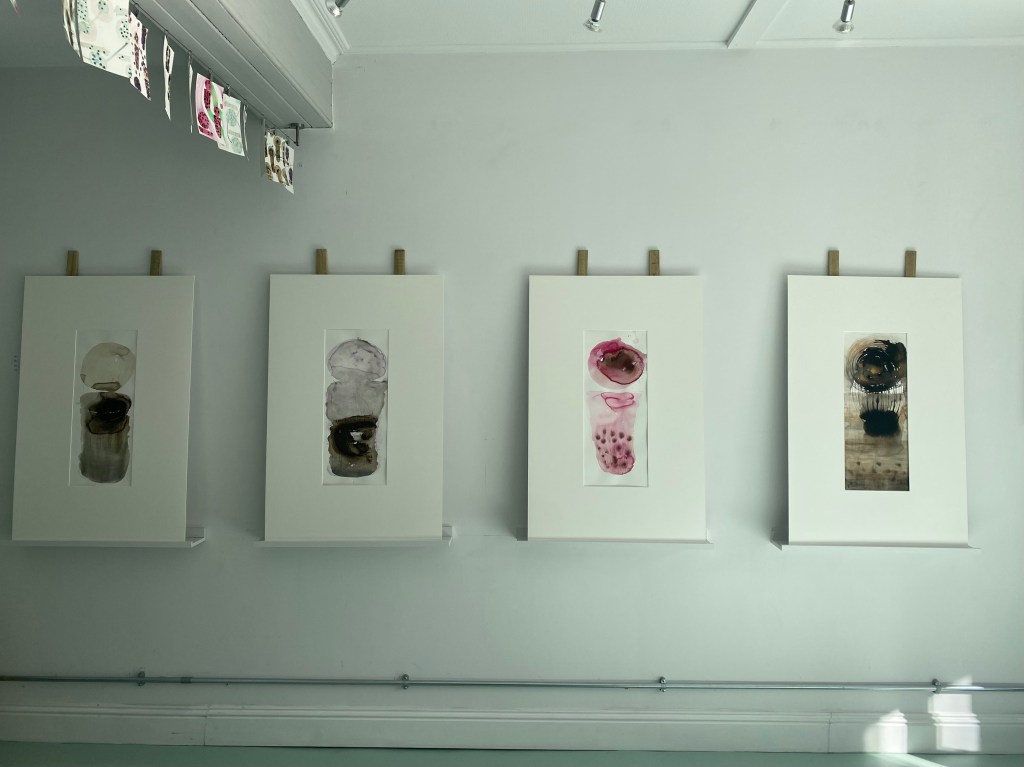
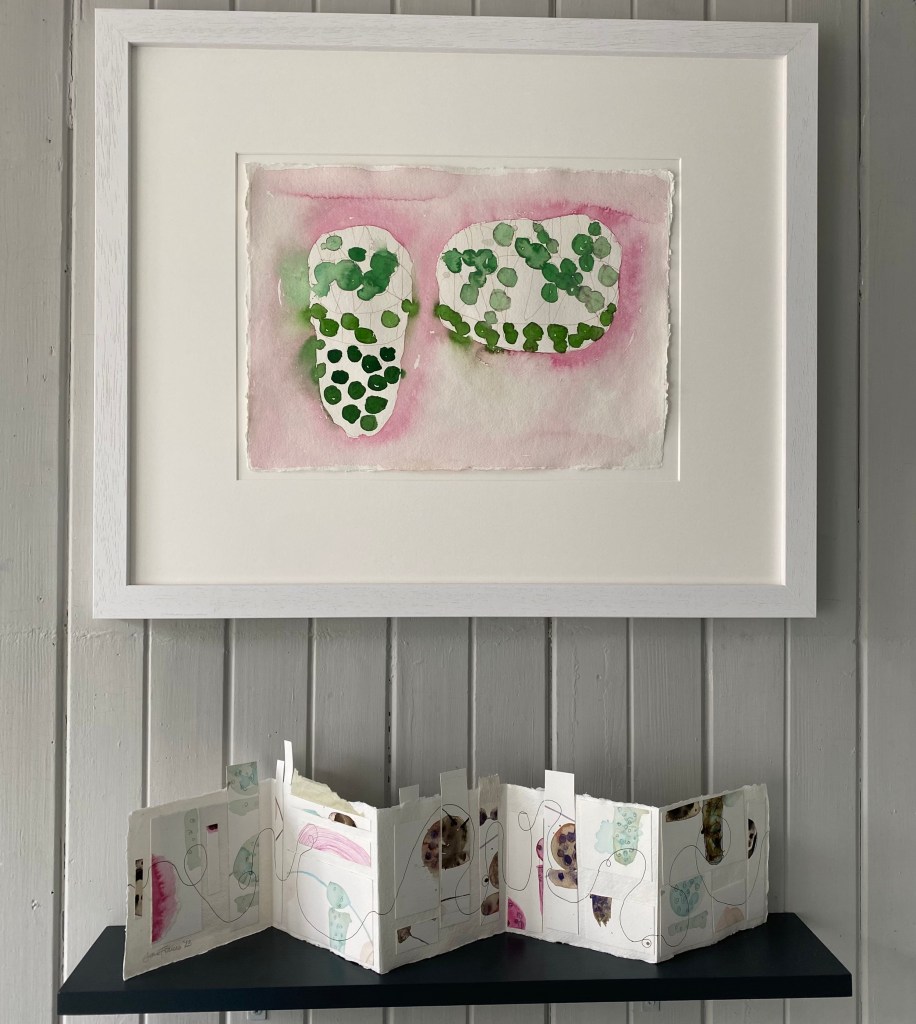
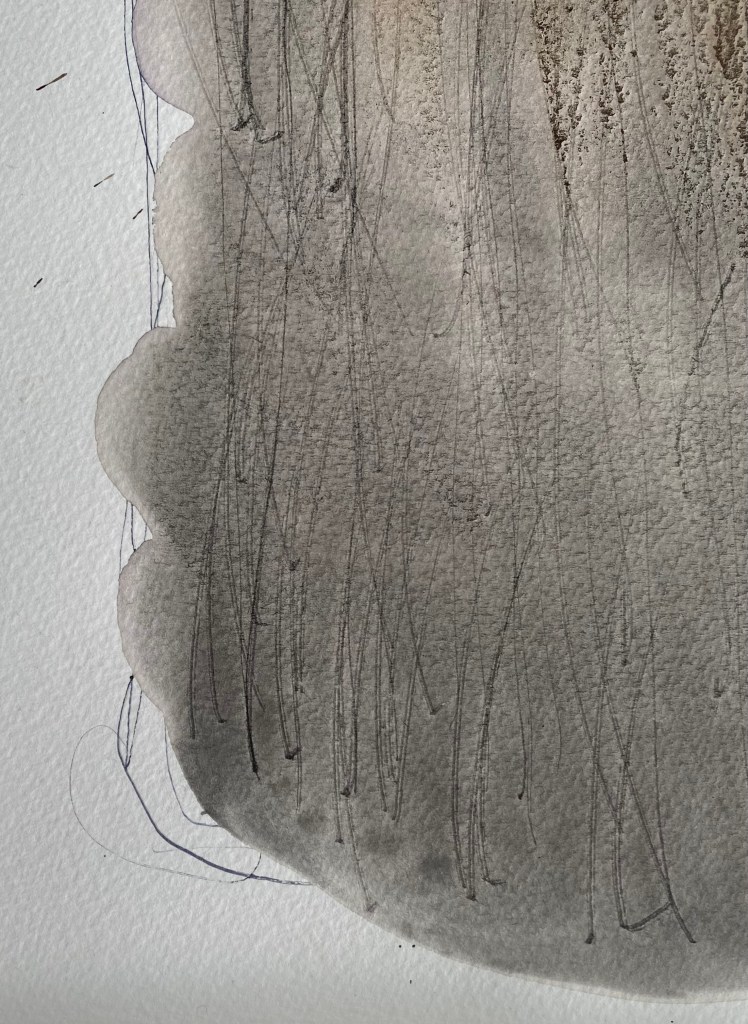
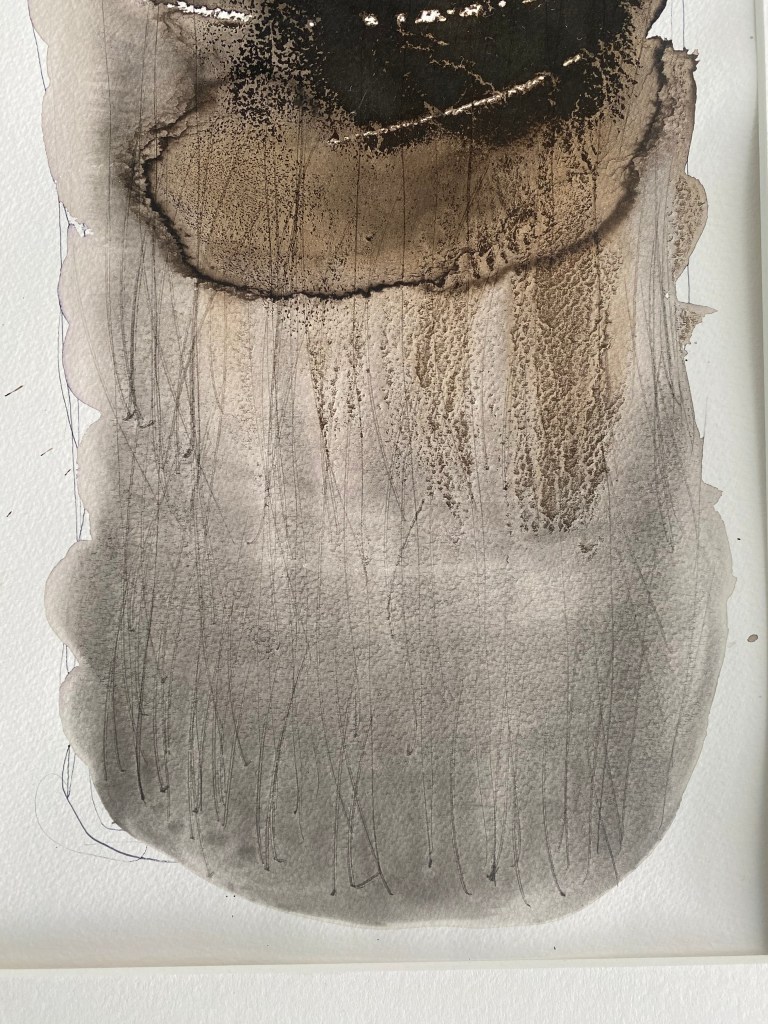
This body of work was created during a period of research and development, for which I was awarded a grant by Creative Scotland’s Create:Inclusion fund in spring 2022. It culminated in an exhibition of a selected pieces in September 2023 at Glisk exhibition space, Burntisland, Fife.
Reading, researching, dreaming…key texts in order of reading
Neuroqueer Heresies: notes on the neurodiversity paradigm, autistic empowerment and postnormal possibilities, Nick Walker, Autonomous Press 2021
A Mismatch of Salience: explorations of the nature of autism from theory to practice, Dr Damien E M Milton, Pavilion Publishing 2017
Authoring Autism / on rhetoric and neurological queerness, Melanie Yergeau, Duke University Press, 2018
Letters to My Weird Sisters: on autism and feminism, Joanne Limburg, Atlantic Books London 2021
Autistic Disturbances: Theorising Autism Poetics from the DSM to Robinson Crusoe, Julie Miele Rodas, University of Michigan Press, 2018
May Tomorrow Be Awake, Chris Martin, Harper Collins 2022
The Kissing of Kissing, Hannah Emerson (poetry), Milkweed Editions 2022
The Wanting Way, Adam Wolfond (poetry), Milkweed Editions 2022
podcast conversation between Katherine May and Bayo Akomolafe, How We Live Now
These Wilds Beyond Our Fences, Bayo Akomolafe, North Atlantic Books 2017
The Minor Gesture, Erin Manning, Duke University Press 2016
Out of the Clear, Erin Manning, Minor Compositions New York, 2023
Introduction to the Poetics of Diversity, Edouard Glissant, trans Celia Britton, Liverpool University Press, 2020
Archipelagos, Édouard Glissant and Hans Ulrich Obrist, trans Emma Ramadan, Isolarii, Common Era Inc 2022
Catnosat: Indigenous Art, Knowledge and Sovereignty, eds Liisa-Ravna Finbog, Katya Garcia-Anton, Beaska Niillas
Empire of Normality: Neurodiversity and Capitalism, Robert Chapman, Pluto Books, 2023
 JANE FRANCIS