Self portrait in progress

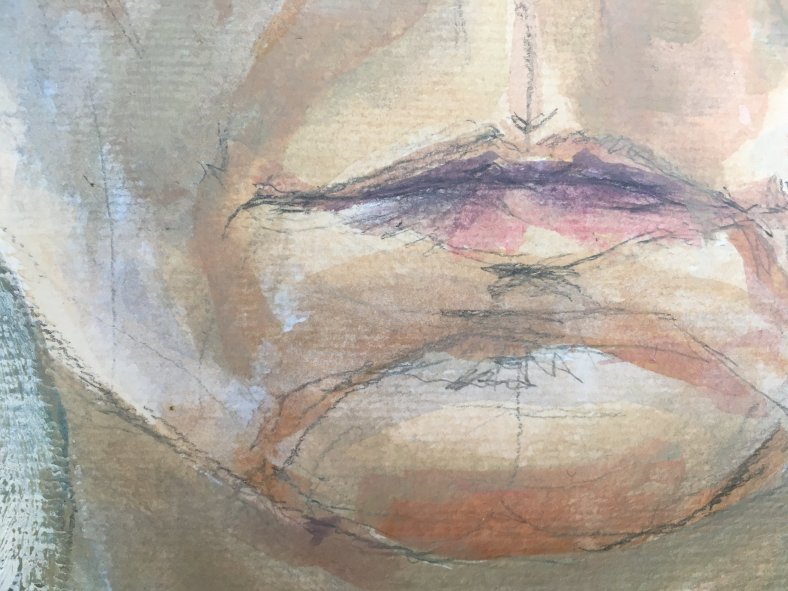
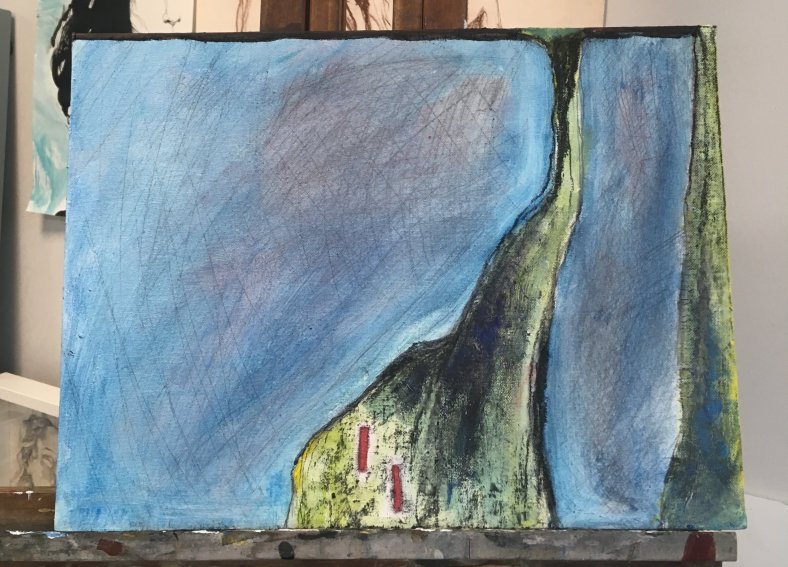
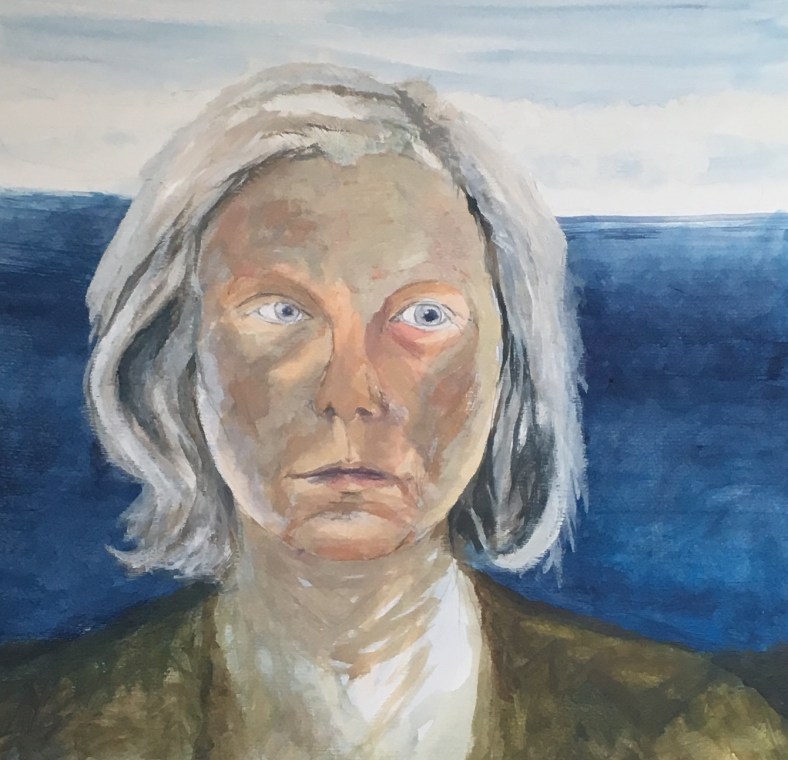
The beginnings of a new self-portrait. I had a photograph I took the day before the accident last July, which has a layer of fluffy white clouds on the horizon. I’ve placed myself, as I am now with my damaged eyes, in front of the landscape from then. My hair is the same colour as the clouds, and my eyes are at the level in the sea where it happened. This place always draws me to look at it when I am close to the sea. I’m not totally sure how I will develop this further, but this is the start.


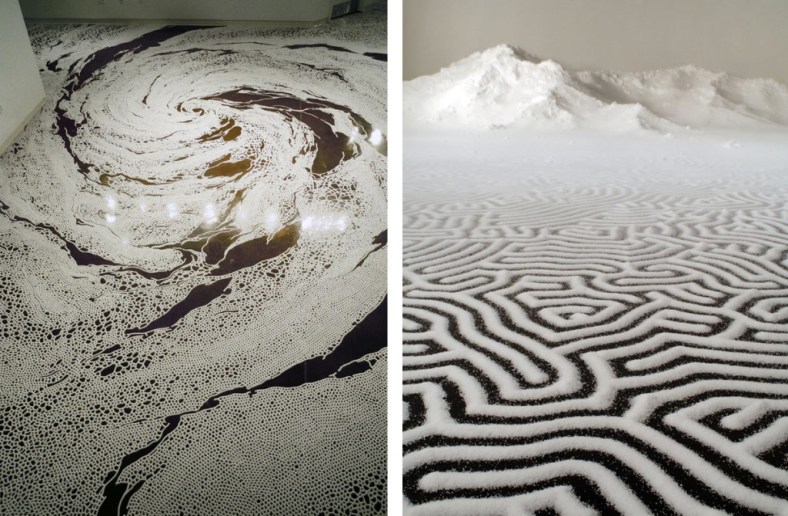
The salt work of Motoi Yamamoto

His inspiration came from grief:

“The mainspring of my work is derived from the death of my sister from brain cancer… Since then, I have had the dilemma, in grief and surprise, of thinking about what I had and lost. I started making art works that reflected such feelings and continue it as if I were writing a diary. Many of my works take the form of labyrinths with complicated patterns, ruined and abandoned staircases or too narrow life-size tunnels, and all these works are made with salt. A common perception towards them is “nearly reachable, yet not quite” or “nearly conceivable, yet not quite”…

Drawing a labyrinth with salt is like following a trace of my memory. Memories seem to change and vanish as time goes by. However, what I sought for was the way in which I could touch a precious moment in my memories which cannot be attained through pictures or writings. What I look for at the end of the act of drawing could be a feeling of touching a precious memory. ” http://thekidshouldseethis.com/post/29465632199

The mathematics of mind-time by Karl Friston

“Consciousness is not a thing but a process of inference’

Complex systems are self-organising because they possess attractors. These are cycles of mutually reinforcing states that allow processes to achieve a point of stability, not by losing energy until they stop, but through what’s known as dynamic equilibrium. An intuitive example is homeostasis. If you’re startled by a predator, your heartbeat and breathing will speed up, but you’ll automatically do something to restore your cardiovascular system to a calmer state (following the so-called ‘fight or flight’ response). Any time there’s a deviation from the attractor, this triggers flows of thoughts, feelings and movements that eventually take you back to your cycle of attracting, familiar states. In humans, all the excitations of our body and brain can be described as moving towards our attractors, that is, towards our most probable states.

On this view, humans are little more than ‘strange loops’, as the philosopher Douglas Hofstadter puts it. We all flow through an enormous, high-dimensional state-space of manifold possibilities, but are forced by our attractors to move around in confined circles. We are like an autumn leaf; tracing out a never-ending trajectory in the turbulent eddies of a stream, thinking our little track is the whole world. This description of ourselves as playful loops might sound teleologically barren – but it has profound implications for the nature of any complex system with a set of attracting states, such as you or me.

….we can talk about inference, the process of figuring out the best principle or hypothesis that explains the observed states of that system we call ‘the world’. Technically, inference entails maximising the evidence for a model of the world. Because we are obliged to maximise evidence, we are – effectively – making inferences about the world using ourselves as a model. That’s why every time you have a new experience, you engage in some kind of inference to try to fit what’s happening into a familiar pattern, or to revise your internal states so as to take account of this new fact. This is just the kind of process a statistician goes through in trying to decide whether she needs new rules to account for the spread of a disease, or whether the collapse of a bank ought to affect the way she models the economy.

Now we can see why attractors are so crucial. An attracting state has a low surprise and high evidence. Complex systems therefore fall into familiar, reliable cycles because these processes are necessarily engaged in validating the principle that underpins their own existence. Attractors push systems to fall into predictable states and thereby reinforce the model that the system has generated of its world. A failure of this surprise minimising, self-evidencing, inferential behaviour means the system will decay into surprising, unfamiliar states – until it no longer exists in any meaningful way. Attractors are the product of processes engaging in inference to summon themselves into being. In other words, attractors are the foundation of what it means to be alive. The Mathematics of Time Aeon Magazine



Work in Progress – Self Portraits

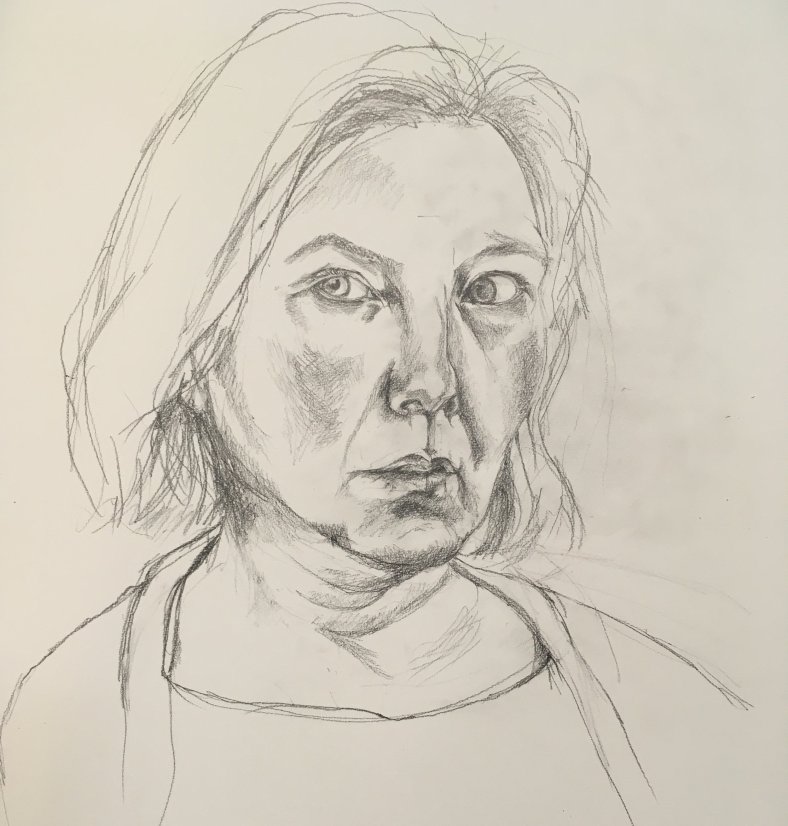
I’ve been working on a series of self-portraits recently, drawing mostly, with the intention of doing some paintings as well. They are portraits of my right eye, which I noticed looked different to the other one, and also different to how it used to look before the retina damage which has made it lose central vision. It looks ‘blown’, with a darker and larger pupil and isn’t focussing – as if its desperately seeking for more information. At first (and perhaps still) it looked frightened, and to me it expressed the fear and pain I had experienced. I felt that it had ‘looked into the abyss’. In the drawings I am trying to capture both the physical change, and also to express some of the fear and loss.

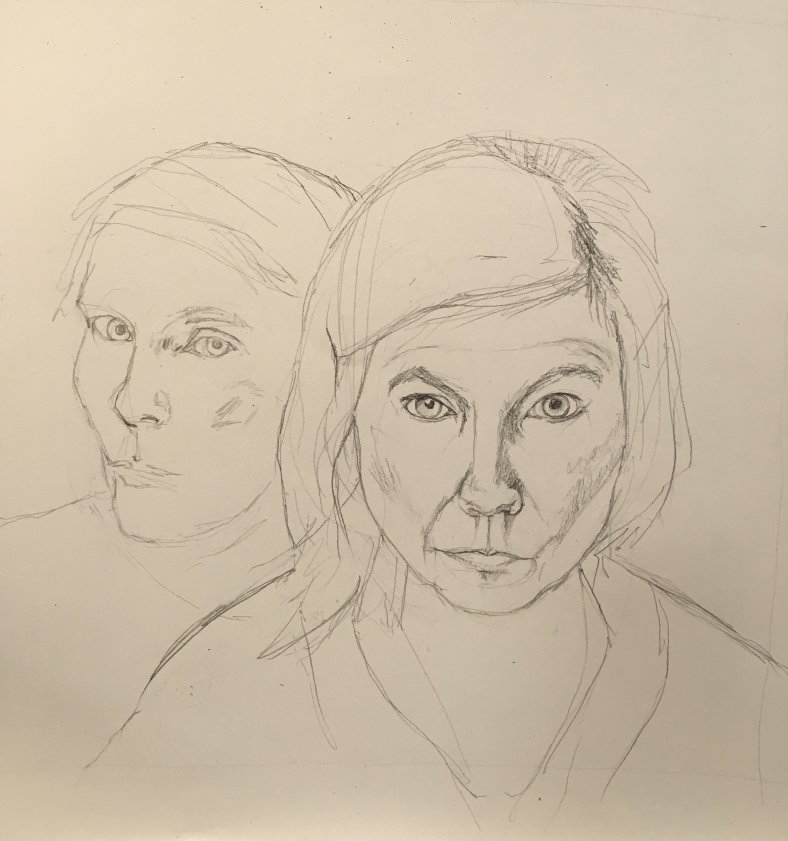
This drawing is a double self portrait. in the background a drawing from a photograph i took in  a mirror – not long after I came out of hospital. in the foreground a portrait from life 8 months later.

The woman in the photo looked raw, thin faced, with a fearful look in her right eye. I wanted to document any changes since then. This idea will probably form the basis of a painting. 

Quote: Mrs Beddows in ‘South Riding’ by Winifred Holtby

“And who are you to think you could get through life without pain? Did you expect never to be ashamed of yourself? Of course that hurts you. And it will go on hurting. You needn’t believe much what they say about time healing. I’ve had seventy years and more of time and there are plenty of things in my life still won’t bear thinking of. You’ve just got to get along as best you can with all your shames and sorrows and humiliations. Maybe in the end it’s those things are most use to you.”

Quote: Teresita Fernandez

“In those moments when you feel discouraged or lost in the studio, or when you experience rejection, rest completely assured that what you don’t know about something is also a form of knowledge, though much harder to understand. In many ways, making art is like blindly trying to see the shape of what you don’t yet know. Whenever you catch a little a glimpse of that blind spot, of your ignorance, of your vulnerability, of that unknown, don’t be afraid or embarrassed to stare at it. Instead, try to relish in its profound mystery. Art is about taking the risk of engaging in something somewhat ridiculous and irrational simply because you need to get a closer look at it, you simply need to break it open to see what’s inside.”