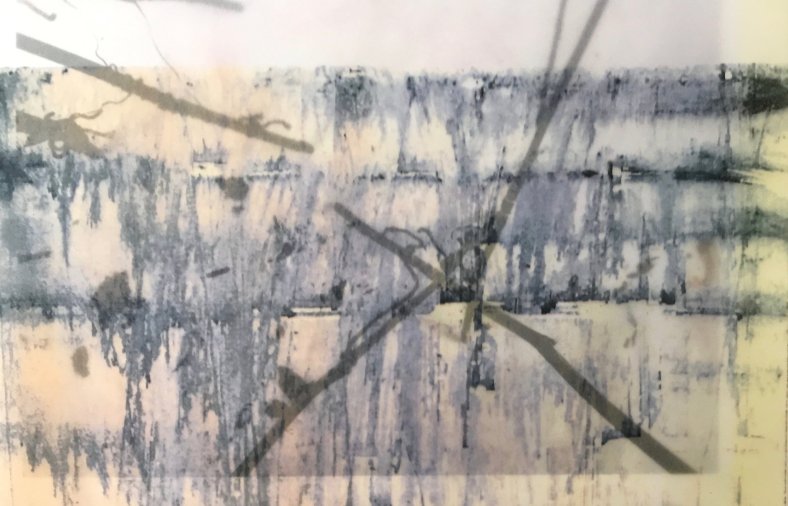
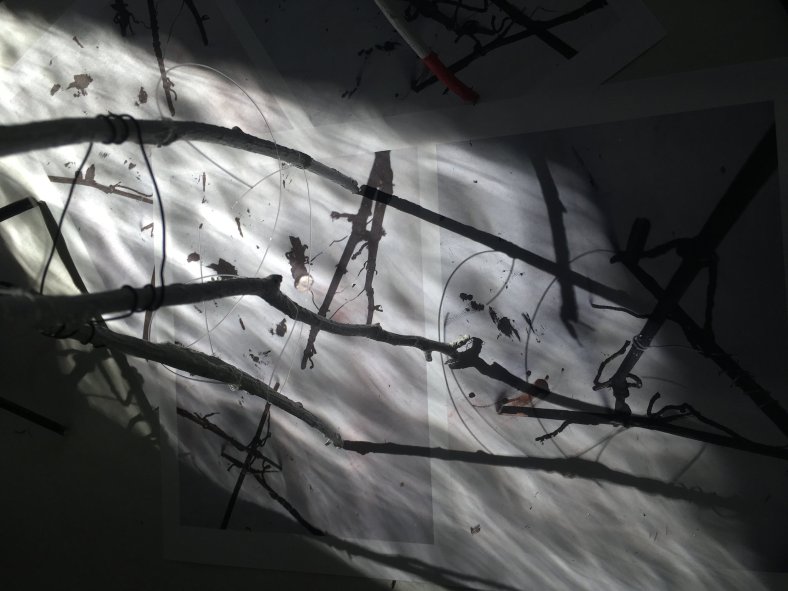
Quote: Rebecca Solnit

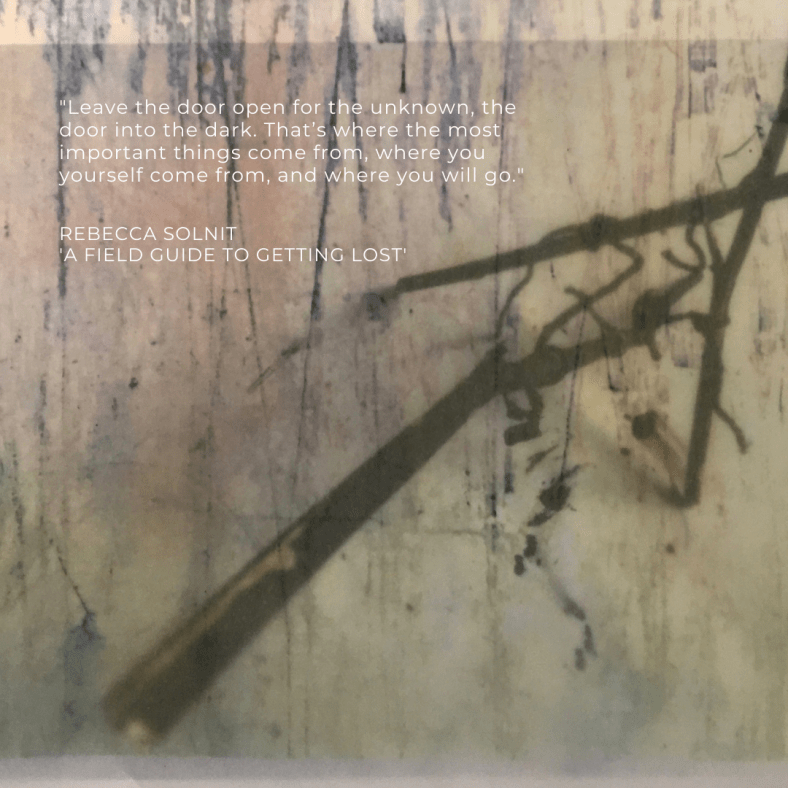
Leave the door open for the unknown, the door into the dark. That’s where the most important things come from, where you yourself come from, and where you will go. Three years ago I was giving a workshop in the Rockies. A student came in bearing a quote from what she said was the pre-Socratic philosopher Meno. It read, “How will you go about finding that thing the nature of which is totally unknown to you?” I copied it down, and it has stayed with me since. The student made big transparent photographs of swimmers underwater, and hung them from the ceiling with the light shining through them, so that to walk among them was to have the shadows of swimmers travel across your body in a space that itself came to seem aquatic and mysterious. The question she carried struck me as the basic tactical question in life. The things we want are transformative, and we don’t know or only think we know what is on the other side of that transformation. Love, wisdom, grace, inspiration – how do you go about finding these things that are in some ways about extending the boundaries of the self into unknown territory, about becoming someone else?

Certainly for artists of all stripes, the unknown, the idea or the form or the talk that has not yet arrived, is what must be found. It is the job of artists to open doors and invite in prophesies, the unknown, the unfamiliar; it’s where their work comes from, although its arrival signals the beginning of the long disciplined process of making it their own. Scientists too, as J. Robert Oppenheimer once remarked, “ live always at the ‘edge of mystery\ – the boundary of the unknown.” But they transform the unknown into the known, haul it in like fishermen; artists get out into the dark sea.

Quote: Rebecca Solnit ‘A Field Guide to Getting Lost’

Glisk: noun, Scots – the glimmer of sunlight through darkening clouds

I’ve been inhabiting my new studio in Burntisland for a few months now, firstly while the two adjoining shops were being fiercely renovated. For the first few months we took lots of layers out, discovering hidden secrets and beauty and history. With each new discovery I considered it carefully, and decided whether to retain or, if the space needed something else, to mark its passing, cover over or remove. This took a few months, then, just as the space was beginning to come together, the first wave of coronavirus lockdown happened.

Luckily the space has its own entrance (2, actually) and soon I was able to begin using it on my own as an actual studio space. I designed it to fit my working practices perfectly, and to accommodate my visual difficulties in particular. It proved to be a good space to work in. I made lots of sculptural vessels, with textured surfaces and paint, ink, crayon and string and thread. They were tactile, they were comforting and reassuring to make. I didn’t manage to really paint, but that’s fine. I know many artists who didn’t make their usual thing during this crisis, and I think that’s healthy. Some were concentrating on life itself, families, worries, worldwide things. I know the saying goes that when life gets tough that’s when artists get working, but I wonder if that work is immediate? I wonder if the work they are doing isn’t actually going on underground, somewhere deep inside. Some artists had a crazy creative period, digging deeper into their practice. Perhaps they were already doing work which addressed what we are collectively feeling, or perhaps that’s just the way they cope. I think either way is fine.

The good news is that the gallery space adjacent to the studio is also nearly complete, and the venture is called Glisk Studios and Gallery Space. I’m gradually gathering the work of artists I find has some connection to my own, and to each other. I like abstraction, curiosity, being surprised and delighted, opening up. The work I’m currently inviting falls into these categories. in future I want to be surprised by new things being shown to me. Then I’ll combine them with my work and with each other and i’m hoping to be delighted again.

I’m going to treat it as an atelier/boutique for a while, opening one day a week, probably a Friday, for ‘open studio’ days. From 11am – 5pm you’re welcome to come in (current restrictions apply) for a browse and a chat. Hopefully soon some local artisans will be coming in to the gallery space on regular Saturday afternoons to set up as a pop-up shop.

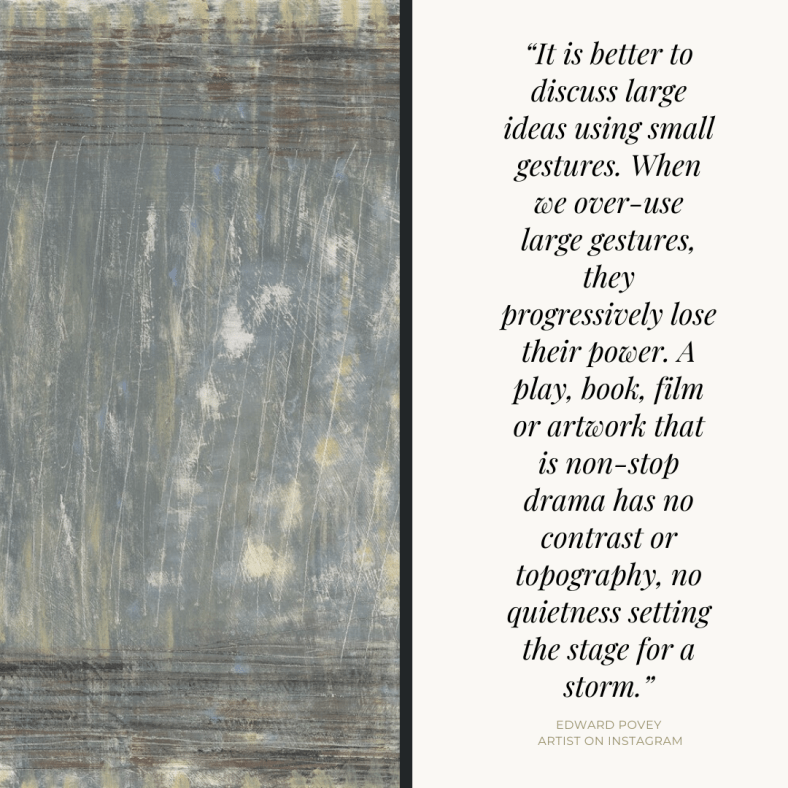
Quote: Edward Povey

It is better to discuss large ideas using small gestures. When we over-use large gestures, they progressively lose their power. A play, book, film or artwork that is non-stop drama has no contrast or topography, no quietness setting the stage for a storm.

— Edward Povey artist on Instagram

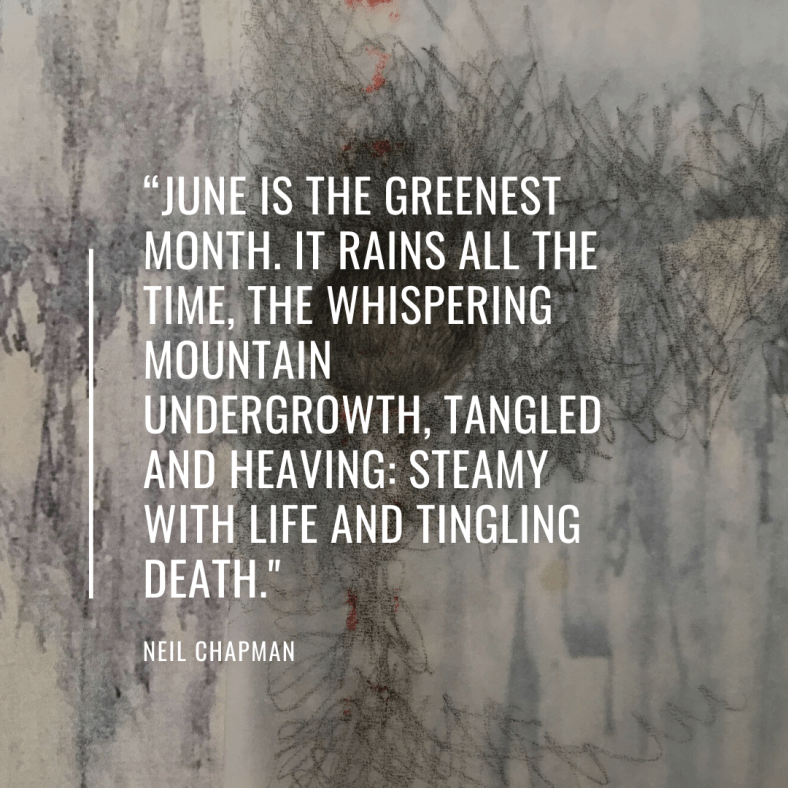
Quote: Neil Chapman

June is the greenest month. It rains all the time, the whispering mountain undergrowth, tangled and heaving: steamy with life and tingling death. Raindrops lodged in a spider’s web, collected; slowly descending along the veins of the leaves of new hydrangea like glass tears. Stems, blades of grass seething with chlorophyll : the slow camera of photosynthesis

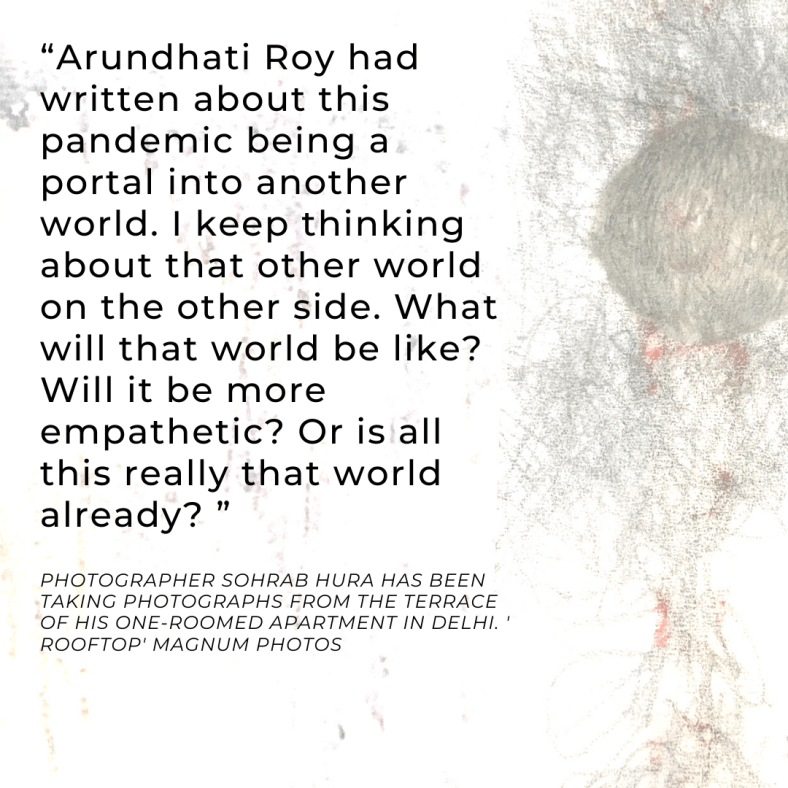
Quote: Sohrab Hura ‘Rooftop’

Arundhati Roy had written about this pandemic being a portal into another world. I keep thinking about that other world on the other side. What will that world be like? Will it be more empathetic? Or is all this really that world already?

— Photographer Sohrab Hura has been taking photographs from the terrace of his one-roomed apartment in Delhi. ‘ Rooftop’ Magnum Photos

Quote: Shaun Tan

We’re so busy talking to ourselves, in a language of our own construction and pleasing ourselves with our own ideas, that we aren’t seeing what we should be seeing….Perhaps these are the dark ages. Every age thinks they are the enlightened ones but we are the barbaric times in someone else’s past. And that bothers me, but it is also inspiring because things can always be better. If someone is reading Tales From the Inner City in 500 years, I hope they think ‘He wasn’t quite there – but he was going in the right direction’.

— Guardian article by Sian Cain on ‘Tales From the Inner City’ by Shaun Tan

The Reality

What I think is that right now human beings are entirely capable, have entirely enough knowledge and capability to do this: we could only use energy transfer to fulfil our needs for warmth and light, we could provide that for every human on earth. We could live entirely respectfully with other forms of life on earth, only using land which has already been used, or use new land but offset it. We could avoid using valuable biodiverse land entirely. We could change our paradigm to believe that being respectful and loving towards our home planet earth is desirable. We could have farms which have a philosophy that they are borrowing land from nature, using it to produce food in ways which work with the seasons and soil health. We could use lots more of countries with small farms, run by families and small firms, who produced food for humans without cruelty to animals or using poison or medicine which harms those who consume it, or destroys or poisons the land around them. I entirely believe this is already within our capabilities as a species.

The fact is that as a species we choose not to do these things. The reason for this is that the number of people who believe this, and even have the knowledge to implement it, are kept away from power. A majority of humans either never think about such things, or are convinced that it is impossible. They think this because they think within a certain paradigm. This paradigm is kept there by a small number of people who want to keep it there for their own enrichment and greed.

That’s it. That’s all.

If you think of it as chimpanzees, with alphas and betas and the rest of us. Alphas are not necessarily wiser or gentler, they’re sometimes just bigger or fiercer or greedier. A group of chimps might have different alphas at different times depending on the needs of the group. Groups of chimps are fiercely competitive with each other, to the point of violence, in order to secure resources.

Humans don’t need to be fiercely competitive any more, but we still behave as if we do. Our brains are wired to feel these things, even when they’re false. We might choose a fierce or greedy alpha, by no means chosen by everyone, but just by a small and powerful pack of betas, even when there is no competition, just because we’re falsely aroused to believe there is one.

I keep thinking of Star Trek. The point of it is that in the future humans have created ways to create an ideal state of living, without competition for resources. They’ve done this by making food reproducible by machine. But this is false. There is no need for this in our ideal scenario. It is false to think that there is a scarcity of resources over which we’re all fighting. There isn’t. We have the knowledge and capacity to make sure this doesn’t happen.

Small farms didn’t disappear because huge intensive farming was the only way to feed a growing population. This is what we’re told to believe. What really happened was that this system, which worked totally fine, wasn’t making lots of money for anyone. And some people’s only raison d’être is to make lots of money for a small number of people. Small farms, lots of them, all over countries, run by families and small companies, works just fine. Different things are grown in different countries and we have the capacity now to share this around. We could totally do that. These farms would be rewarded for their excellence in keeping clean of poisons, of working with nature, and for creating and encouraging and working around biodiversity, wild-ness and respect. The farms would provide a livelihood for the farmers and companies and those who worked for them. They would be rewarded for making sure everyone involved knew what to do.

We have the capacity as a species to understand biodiversity and abundance as key principles for all actions, in particular actions directly on land. We choose not to do this. There is disagreement because old fashioned ‘knowledge’ of land management is based around entirely false premises. From neatness to forms of culling to burning heather to digging up peat. We know what is right now from what is wrong, if you keep the survival of the planet as your base line of achievement. If you don’t keep this as your base line, and many don’t, then you act in all sorts of ways which directly go against this trajectory.

If your actions go against this trajectory, you are doing the wrong thing.

I’m talking about change though. I’m not talking about you and you and you and your actions, whether you should really buy that top, or that ready meal, or take that plane journey to a holiday destination. I mean that as a species we know what to do.

But we’ve never thought of ourselves as a species. We’re too bound up with being ourselves to look outside ourselves. Those who do, many wise people, are kept away from day to day life. Without a sense of how we fit in to the planet with the other species we share it with, we cannot change. We’re both entirely alone, cut off from our connection to earth, obsessed with ourselves, and yet unable to see ourselves as a whole.
Quote: Peter Green

So much workmanship is that of certainty when you know the result before you start and that is very dispiriting. Whereas if you do not know it – if it’s the workmanship of uncertainty – you don’t know the result and that’s a nice definition of creativity.