A course and an exhibition

The first thing I want to mention is that I took part in a week long course a couple of weeks ago, and the tutelage of Fraser Taylor, entitled ‘develop your studio practice’, I wanted to spend some dedicated time trying to see if I could pull together some of the strands I’ve been following over the last few months, grappling with ideas for making art related to my experiences of being involved in a serious accident which resulted in sight loss. The sense of being in a liminal state pervaded my life afterwards, and one of the only ways I could feel my way through it was to try and express it through making art in various forms. But how to pull together something which was by its essence broken, fragmented, full of blanks (like my eyesight, and memory) and without a visible end? The course was excellent and Fraser immediately grasped what I was saying and understood that the liminal happens also on the verges of different forms of art, which was also something I was drawn to. The sense of feeling my way (blindly) isn’t something I need to resist, in itself this mirrors the experience. I pull together as best I can, but the gaps keep opening, resisting any attempts to be controlled. This is, surely a creative process in itself. The end result can only be an exhibition, or perhaps a small scale exhibition in the form of a book, or a few books…..

Saying that, next week I am putting some work of mine up together in one space for an open studios event and following exhibition. This is for the ‘outward me’ to put some work into public and see what happens.  

Quote: Anhoni

“I am from peasant stock with a shit degree in art – I’m a nothing,” she says. “But it doesn’t take an expert to diagnose the whole stinking system. I talk to a taxi driver from Pakistan and they’re saying the same thing as me. Everyone’s feeling it. David Attenborough’s feeling it; all the people we trust are feeling it. Can we address it? Can we inhale it? Can we withstand it?” https://www.theguardian.com/music/2016/apr/09/trans-singer-anohni-new-album-hopelessness

Frustrated with myself…

I’m feeling very frustrated right now because I have this tendency to work on something and then sabotage it. I’ll follow an idea, one which I might have worked on mentally outwith the studio, and by the time I get to the canvas I have a clear purpose. Then I execute it, give or take the usual varieties of unexpected moments, which are good and productive. Then I go away but when I return I look at the piece and feel self doubt. Will people think I haven’t thought this through? Will they think it looks poorly executed? Does it look like something else (a head, a face). So I carry out some sort of vandalism on it. I think at the time I’m ‘working’ on it to improve it. Then I go back again later, I see the photographs I have taken of it previously and I’m furious to discover that it was actually exactly as I had wanted it to be, but I have spoiled it.

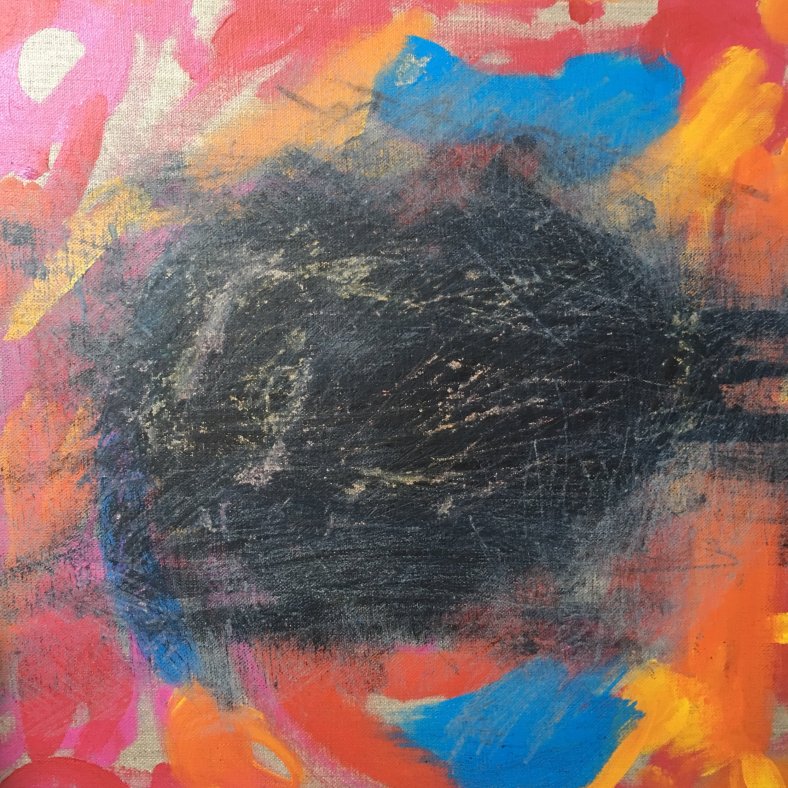
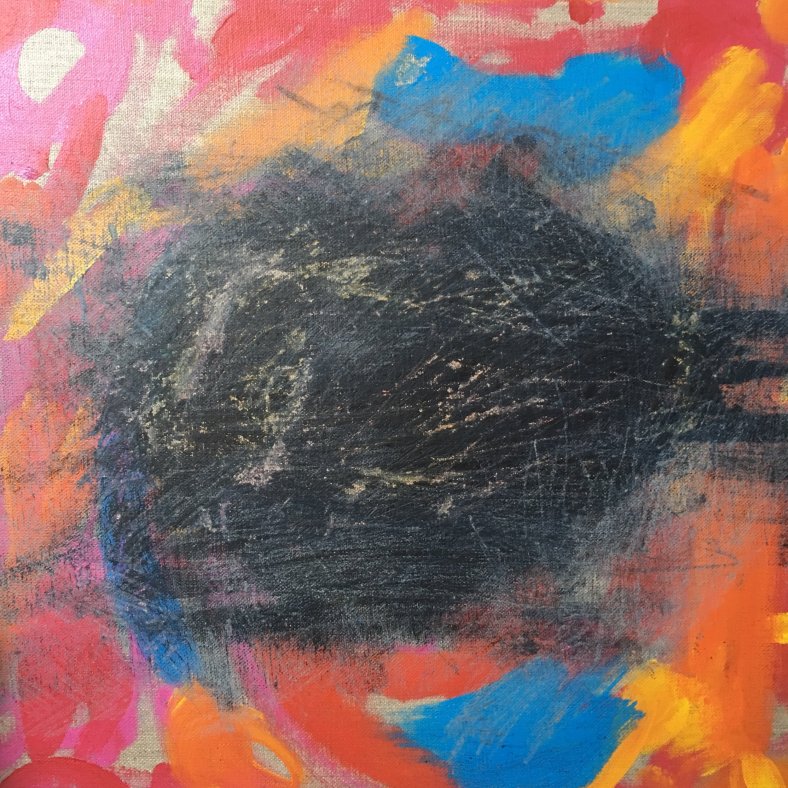
Here is an example. I wanted this to be a background of pure and simple colours, joyfully springing about, not my usual thing at all. I was delighted to use pink and red. This was a moment of pure painterly joy, balancing as you go, making movements with surety. Then the foreground was to be a lurking darkness, a sinister ‘being’ hovering over the joyfulness of the background. The painting represented to me the world of sight and joy which is now cut off for my right eye. It represents the horror I feel when I close my left eye and look only with my right. If both eyes were affected the same this is what it would be like to see the world at all. That I can still see things of joy with my left eye is so important and precious to me.

But when I went back I doubted my work. I painted first an indigo wash, and then a blood red one over that. The bright true colours are gone, although the pinks and reds are still visible. I was pulled into thinking I had to verify my work against some imagined critic. This makes me think that I need to work more in a tutored environment, where someone can recognise my work as it is in progress. By working in a vacuum where I produce and then sell, I feel rather lost. I have also learned from this though, I am much less likely to trust this horrible tendency to change things when I hear horrible criticisms in my mind. it is probably wrong!. Having confidence while you are working is one of the hardest things of all!

Here is the original painting:

Vision test

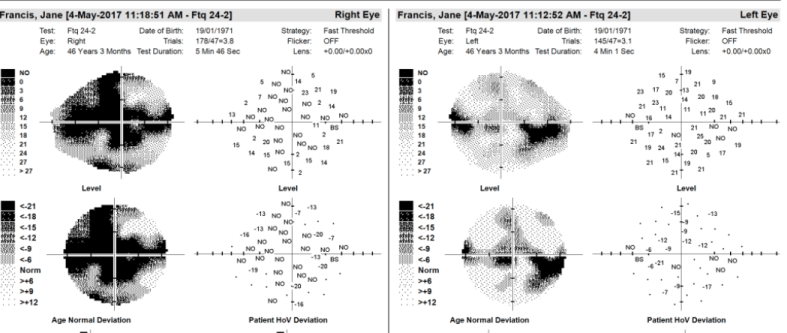
a test of my visual field. A very graphic representation of what I see. It is the closest I’ve been able to get of a subjective sense of my vision after a traumatic accident last year caused retinopathy in both my eyes. The top left image is a representation of when I could see a small flashing light on a screen, and at what brightness I could see it. The black is marked NO, i.e. no vision, and the gradations around it represent how bright the light needed to be in order for my eye to see it. The bottom left image is a comparison with normal vision i.e. ‘Norm’. The images on the right are my left eye. I knew that it’s  wasn’t totally normal, there there was damage around the edges, but it just feels ‘reduced’ rather than having an actual blank spot as in my right eye. These images lend themselves to making art which express the subjective experience of low vision. I’ve started with a simple drawing of the right eye’s vision:

Self portrait in progress

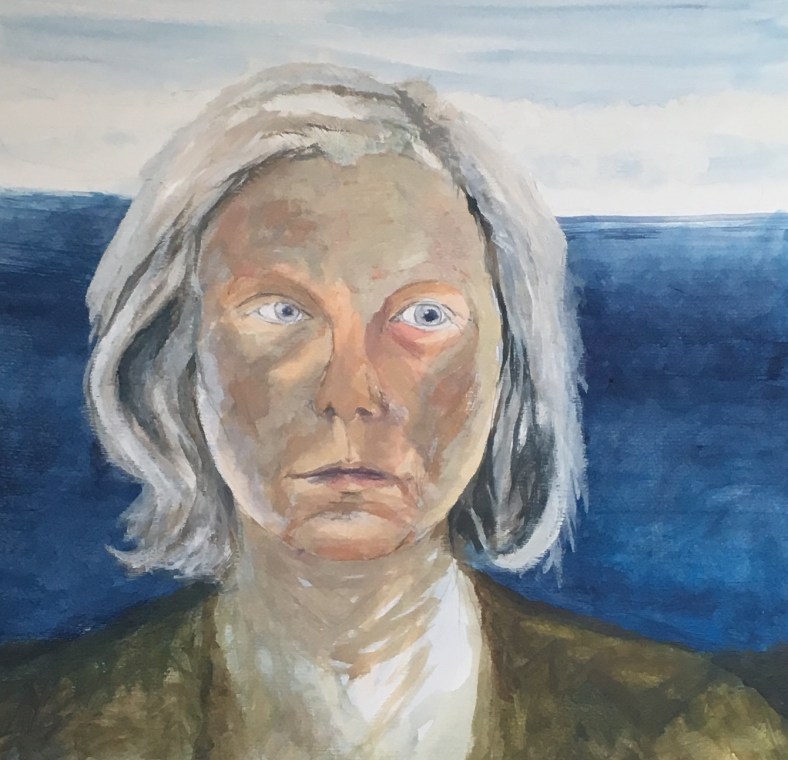
The beginnings of a new self-portrait. I had a photograph I took the day before the accident last July, which has a layer of fluffy white clouds on the horizon. I’ve placed myself, as I am now with my damaged eyes, in front of the landscape from then. My hair is the same colour as the clouds, and my eyes are at the level in the sea where it happened. This place always draws me to look at it when I am close to the sea. I’m not totally sure how I will develop this further, but this is the start.


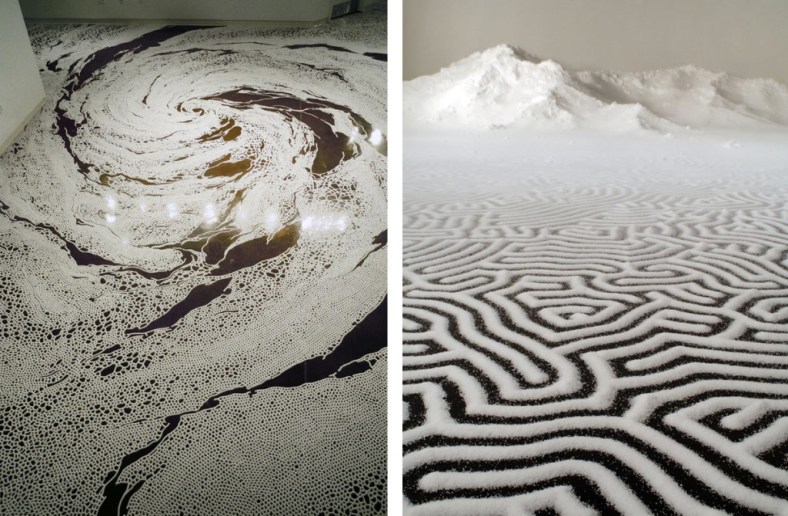
The salt work of Motoi Yamamoto

His inspiration came from grief:

“The mainspring of my work is derived from the death of my sister from brain cancer… Since then, I have had the dilemma, in grief and surprise, of thinking about what I had and lost. I started making art works that reflected such feelings and continue it as if I were writing a diary. Many of my works take the form of labyrinths with complicated patterns, ruined and abandoned staircases or too narrow life-size tunnels, and all these works are made with salt. A common perception towards them is “nearly reachable, yet not quite” or “nearly conceivable, yet not quite”…

Drawing a labyrinth with salt is like following a trace of my memory. Memories seem to change and vanish as time goes by. However, what I sought for was the way in which I could touch a precious moment in my memories which cannot be attained through pictures or writings. What I look for at the end of the act of drawing could be a feeling of touching a precious memory. ” http://thekidshouldseethis.com/post/29465632199

The mathematics of mind-time by Karl Friston

“Consciousness is not a thing but a process of inference’

Complex systems are self-organising because they possess attractors. These are cycles of mutually reinforcing states that allow processes to achieve a point of stability, not by losing energy until they stop, but through what’s known as dynamic equilibrium. An intuitive example is homeostasis. If you’re startled by a predator, your heartbeat and breathing will speed up, but you’ll automatically do something to restore your cardiovascular system to a calmer state (following the so-called ‘fight or flight’ response). Any time there’s a deviation from the attractor, this triggers flows of thoughts, feelings and movements that eventually take you back to your cycle of attracting, familiar states. In humans, all the excitations of our body and brain can be described as moving towards our attractors, that is, towards our most probable states.

On this view, humans are little more than ‘strange loops’, as the philosopher Douglas Hofstadter puts it. We all flow through an enormous, high-dimensional state-space of manifold possibilities, but are forced by our attractors to move around in confined circles. We are like an autumn leaf; tracing out a never-ending trajectory in the turbulent eddies of a stream, thinking our little track is the whole world. This description of ourselves as playful loops might sound teleologically barren – but it has profound implications for the nature of any complex system with a set of attracting states, such as you or me.

….we can talk about inference, the process of figuring out the best principle or hypothesis that explains the observed states of that system we call ‘the world’. Technically, inference entails maximising the evidence for a model of the world. Because we are obliged to maximise evidence, we are – effectively – making inferences about the world using ourselves as a model. That’s why every time you have a new experience, you engage in some kind of inference to try to fit what’s happening into a familiar pattern, or to revise your internal states so as to take account of this new fact. This is just the kind of process a statistician goes through in trying to decide whether she needs new rules to account for the spread of a disease, or whether the collapse of a bank ought to affect the way she models the economy.

Now we can see why attractors are so crucial. An attracting state has a low surprise and high evidence. Complex systems therefore fall into familiar, reliable cycles because these processes are necessarily engaged in validating the principle that underpins their own existence. Attractors push systems to fall into predictable states and thereby reinforce the model that the system has generated of its world. A failure of this surprise minimising, self-evidencing, inferential behaviour means the system will decay into surprising, unfamiliar states – until it no longer exists in any meaningful way. Attractors are the product of processes engaging in inference to summon themselves into being. In other words, attractors are the foundation of what it means to be alive. The Mathematics of Time Aeon Magazine